
When traveling in Amsterdam, in The Netherlands; I came across the stumbling stones.
Scattered across Europe, planted firmly in the streets and sidewalks of cities whose past is not forgotten, small brass memorial plaques perpetuate the lives lost in the great tragedy of the 20th century.
A nice way to keep the money alive.
The Stumbling Stones project was developed by German artist Gunter Demnig, who was inspired by a quote from the Talmud: “A person is only forgotten when his name is forgotten.”
The first stumbling stones were laid for Sinti in Cologne in January 1995, but Gunter Demnig’s artistic work of ‘laying tracks’ dates back to the early 1980s.
However since 1995, the stumbling stone has evolved into the world’s largest decentralized memorial.
In German it’s called a Stolperstein.
Literally, it means ‘stumbling stone’ and metaphorically ‘stumbling block’. But you’re not supposed to trip over it with your feet, but as a little boy once said to Gunter Demnig: “You should stumble with your head and with your heart”.
The Stumbling Stone is made from a granite cobblestone with a brass plate engraved with the names of Holocaust victims and others.
The Stumbling Stone is placed next to the victim’s last voluntary residence – in some cases, it may be placed in front of the person’s workplace. In Denmark, for example, this is the case with physicist Niels Bohr, on Blegdamsvej, at Arne Jacobsen’s residence in Charlottenlund and several others.
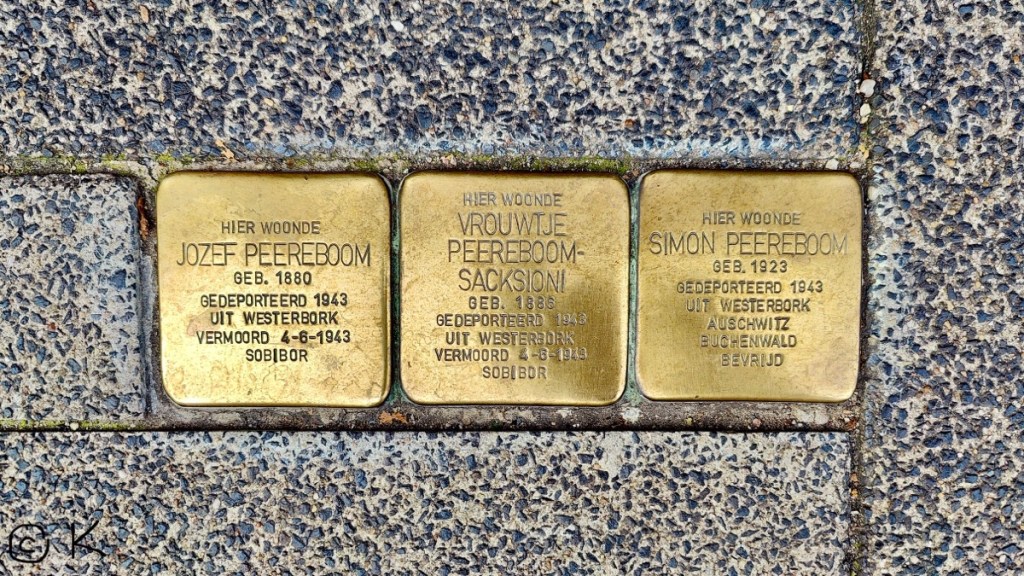
From the beginning, stumbling blocks have been for all victim groups: Roma, Sinti, Jews, homosexuals, the politically persecuted, resistance fighters, Jehovah’s Witnesses and the so-called “euthanasia” victims, as well as for survivors of persecution. If you have been in a concentration camp or had to flee your home, you are also a victim of the Nazis.
Gunter Demnig’s basic idea is that stumbling blocks are a citizens’ movement: the initiative must come from the citizens, not from the state or municipality.
As far as possible, Gunter Demnig lays the stumbling blocks himself.
Since 2005, the stones have been handmade by artist Michael Friedrichs-Friedlaender in his Berlin workshop. He and his two assistants produce 400-500 stumbling blocks per month.
Gunter Demnig describes the large number of stumbling blocks and the many people involved in the project across Europe as a social sculpture. He is inspired by the ideas of artist Joseph Beuys, a German conceptual artist, sculptor, draughtsman, art theorist and professor at the Düsseldorf Art Academy.
 Insight and Visions